
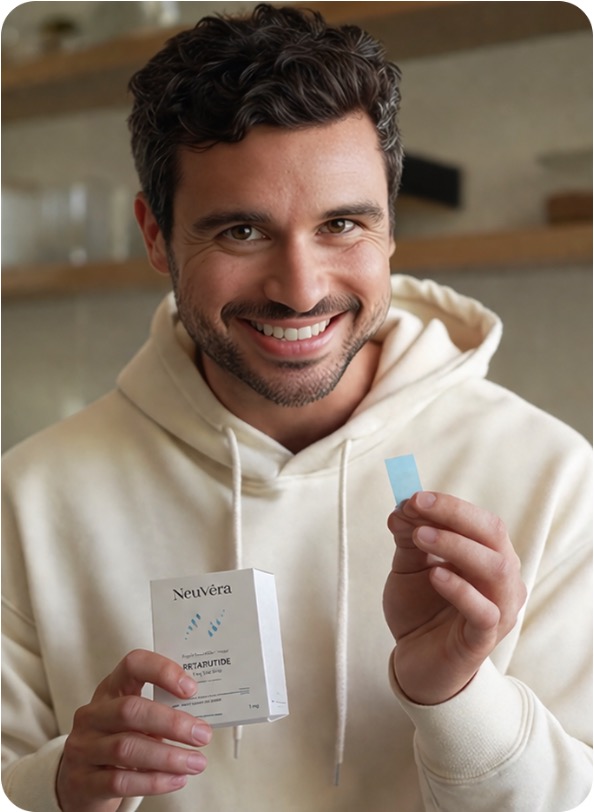
4 Best Peptides for Cellular Repair: Types & Benefits Explained
Discover the best peptides for cellular repair, from tissue recovery to cell energy and skin collagen, and how Neuvera makes daily dosing simple. Read on.
Key Takeaways
BPC-157, TB-500, NAD+, and GHK-Cu are four well-studied compounds in cellular repair, though only three of them are truly peptides.
BPC-157 and TB-500 are lab-made peptides often paired together in recovery routines, each linked to a different part of the process.
NAD+ is a coenzyme that supports cellular energy production and DNA maintenance, though levels fall with age in tissues including skin.
GHK-Cu is a copper peptide the body produces naturally, and its supply drops sharply by around age 60, which tracks with weaker collagen and slower skin renewal.
Neuvera sells BPC-157 with TB-500, or NAD+, as pre-measured oral dissolving strips that need no injections or refrigeration, with 92.5% absorption in its own clinical study.
How Do Peptides Support Cellular Repair?
Peptides act like signals. They tell cells where to go and what to make, rather than rebuilding tissue directly. BPC-157, TB-500, NAD+, and GHK-Cu are four of the most researched compounds for cellular repair, and each one is linked to a different stage of the process. That is why the right choice depends on your goal.
The compound is only half the decision. Delivery controls how much actually reaches your cells, and many peptide products rely on injections, mixing, and cold storage, which make a daily routine hard to maintain. Quality also varies sharply between online sellers, so published absorption data matters as much as the label.
Neuvera builds its range around both problems. Its pre-measured oral strips cover tissue recovery with BPC-157 and TB-500 and cellular energy with NAD+, while its topical Peptide G63™ line supports daily skin care.
4 Types of Peptides That Help Keep Your Cells Healthy
1. BPC-157
BPC-157 stands for Body Protection Compound-157. It is a lab-made chain of 15 amino acids, copied from a protein in stomach fluid. Animal and lab studies have looked at it closely, and they suggest it supports the body's natural recovery processes.
Benefits
BPC-157 works as a coordinator of recovery. It is associated with helping your body's own repair signals work together, so tissue stays maintained and balanced. Rather than doing the rebuilding itself, it seems to help organize the effort. Neuvera offers BPC-157 with TB-500 as a pre-measured oral dissolving strip.
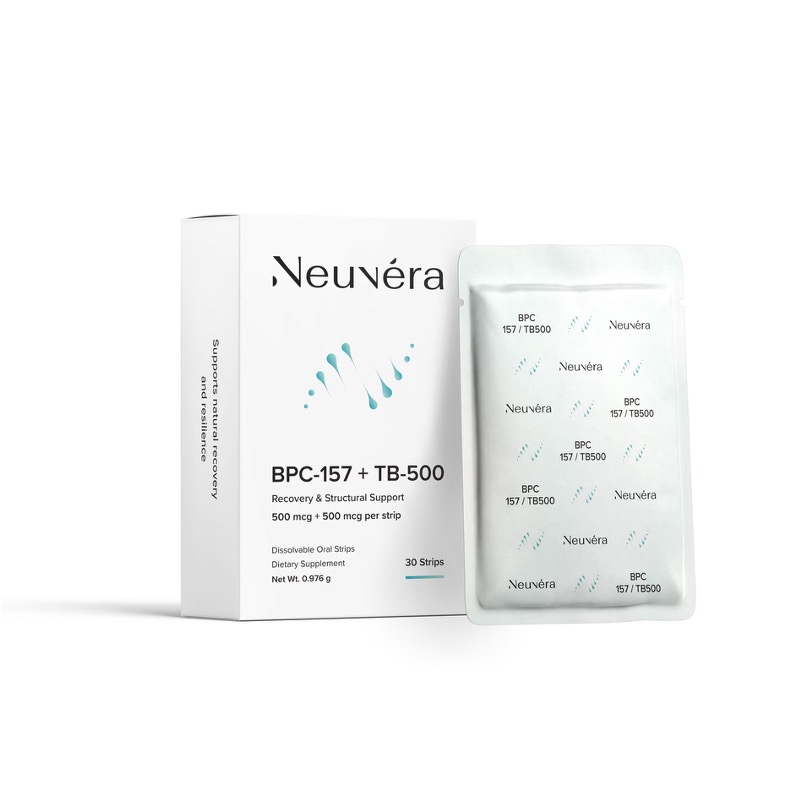
Neuvera BPC-157 + TB-500 oral dissolving strips can be used for recovery and structural support.
2. TB-500 (Thymosin Beta-4 Fragment)
TB-500 is a lab-made fragment of Thymosin Beta-4, a 43-amino-acid protein found in almost every cell in your body. It regulates actin, the protein that gives cells shape and lets them move and repair after damage.
Actin is one of the body's most abundant proteins, and TB-500's ability to modulate it gives this peptide broad influence over cellular repair mechanisms.
Benefits
If BPC-157 organizes the recovery effort, TB-500 is linked to the movement side of it. It is associated with helping cells travel where they are needed, which may support tissue that must stretch, bend, and bounce back. Researchers continue to study its role in recovery.
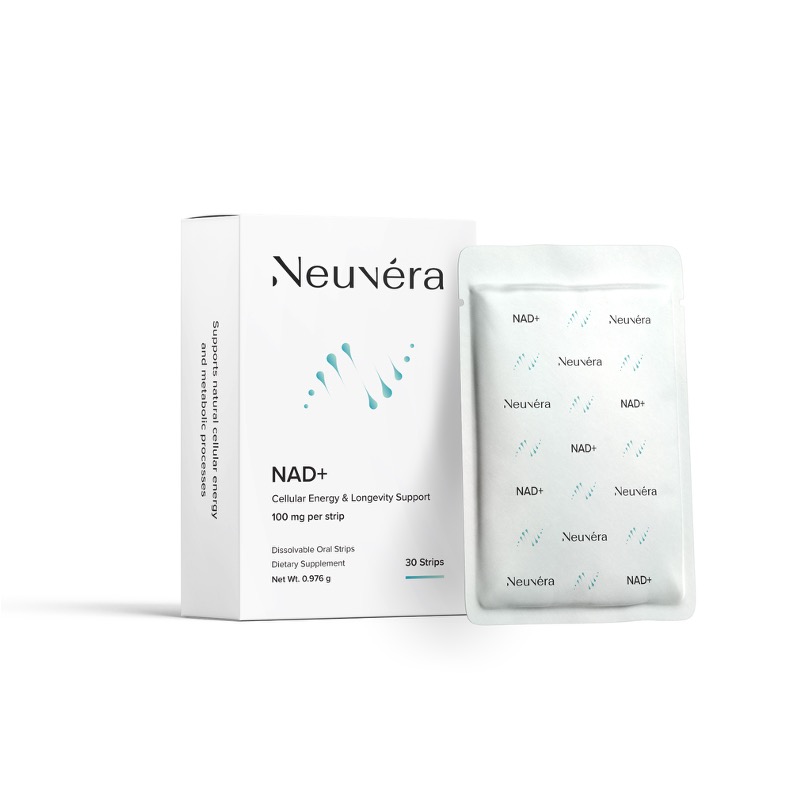
Neuvera NAD+ oral dissolving strips are designed for daily cellular energy support.
3. NAD+
NAD+ (Nicotinamide Adenine Dinucleotide) is a helper molecule in every living cell, and it powers how cells make energy. It is a helper compound (a coenzyme), not a peptide. It is also linked to DNA maintenance and to proteins that help manage how cells age.
NAD+ appears to drop with age in several tissues, including skin. Lower levels line up with slower repair and weaker mitochondria, the tiny engines inside your cells. The size of the drop depends on the tissue and how it is measured. Topping it back up is a busy research area, with early results only.
Benefits
NAD+ sits on the energy side of the story. It may help cells turn fuel into usable energy and keep their day-to-day housekeeping running. It is also linked to pathways researchers connect with healthy aging.
4. GHK-Cu
GHK-Cu is a copper peptide your body already makes. It is a short chain of three amino acids, glycine, histidine, and lysine, attached to a single copper atom.
Young adults carry plenty of it, which keeps skin repairing itself quickly. By around age 60, supply has fallen sharply, which aligns with slower skin renewal, less collagen, and thinner, more fragile skin.
Benefits
GHK-Cu may nudge several skin renewal processes at once. It is associated with collagen and elastin production, the fibers that keep skin firm and springy. It is also linked to antioxidant activity in skin.
Peptides for Cell Repair: Summary Table
Peptide | Primary Role | Best For |
BPC-157 | Supports the body's own repair signaling | Recovery routines |
TB-500 (Thymosin Beta-4 Fragment) | Binds actin and supports cell movement during recovery | Movement and recovery support |
NAD+ (coenzyme) | Powers cell energy metabolism and cellular housekeeping | Daily cellular energy |
GHK-Cu | Linked to collagen and elastin production | Firmness, smoothness, skin renewal |
Build a Daily Cellular Repair Routine with Neuvera
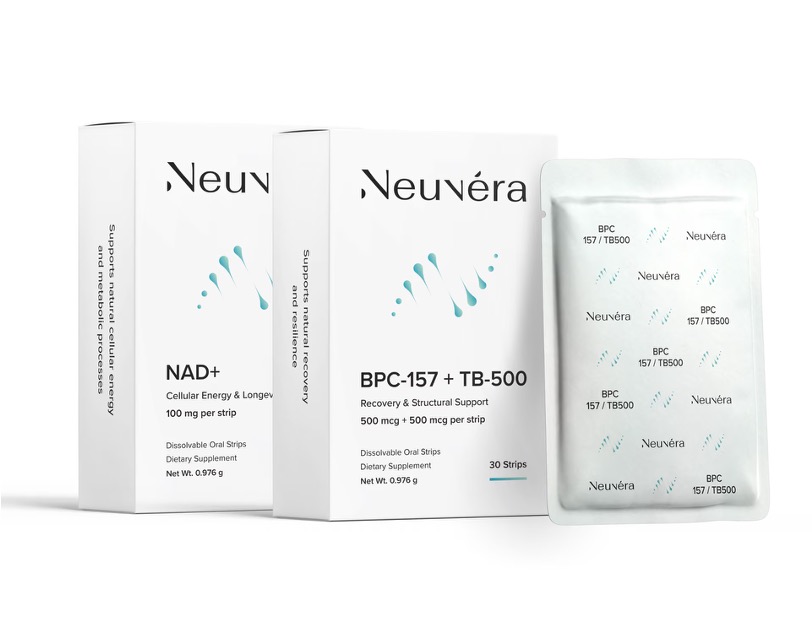
At Neuvera, our Recovery & Repair Routine pairs NAD+ with BPC-157 + TB-500 in a simple daily wellness routine.
The best peptide for cellular repair depends on what needs repairing. BPC-157 and TB-500 suit recovery routines, NAD+ supports cell energy as levels fall with age, and GHK-Cu is linked to collagen and skin renewal. Match the compound to your goal, then pick a delivery method you can keep up daily.
At Neuvera, we make that daily habit simple. Our pre-measured oral strips deliver BPC-157 + TB-500 or NAD+ with no needles, no refrigeration, no mixing, and no measuring, and our own clinical study recorded 92.5% absorption. Want both? The Recovery & Repair Routine pairs NAD+ with BPC-157 + TB-500 in one simple daily routine. Browse our daily wellness strips and start your cellular repair routine today.
Frequently Asked Questions (FAQs)
What is the best peptide for cell repair?
The best peptide for cellular repair depends on your goal. For recovery routines, people often pair BPC-157 and TB-500 because each supports a different part of the recovery process. For daily cellular energy, NAD+ is a popular choice, and Neuvera offers it as a pre-measured oral dissolving strip.
Can I buy peptides online?
Yes, peptides are widely sold online, but quality varies sharply between sellers. Look for companies that publish their absorption data, name their formulation science, and clearly explain delivery methods. Neuvera publishes its absorption data and explains its delivery format clearly.
How do I increase my peptides?
Start with the basics: enough protein, consistent sleep, resistance training, and less alcohol all support overall wellness. From there, a simple daily routine can help, whether that means a daily topical peptide for skin or a daily BPC-157 + TB-500 strip routine.
Who should avoid taking peptides?
Peptide routines are not for everyone. If you are pregnant, breastfeeding, or have any health concerns, speak to a qualified healthcare professional before starting any peptide routine, and check ingredient lists closely. Competitive athletes should note that WADA prohibits both BPC-157 and TB-500 in sport.
What is Neuvera?
Neuvera is a peptide wellness company that builds its products on peptide research rather than trends. Its range includes pre-measured oral dissolving strips, such as BPC-157 + TB-500 for recovery routines and NAD+ for daily energy, plus a topical line built on Peptide G, a patented peptide portfolio. RapidRelease™ Technology supports fast absorption of the daily wellness strips, with the company's own clinical study reporting 92.5% absorption.
*Disclaimer: The information in this article is for general informational purposes only and is not intended as medical advice, diagnosis, or treatment. Neuvera's products are not pharmaceutical products. Individual results may vary. Always consult a qualified healthcare professional before starting any new wellness routine.
Written by Cody Nickson
READY TO CHOOSE?
Find your daily strip routine.
Answer one simple question: what are you building around? Then compare Neuvéra routines by goal.