
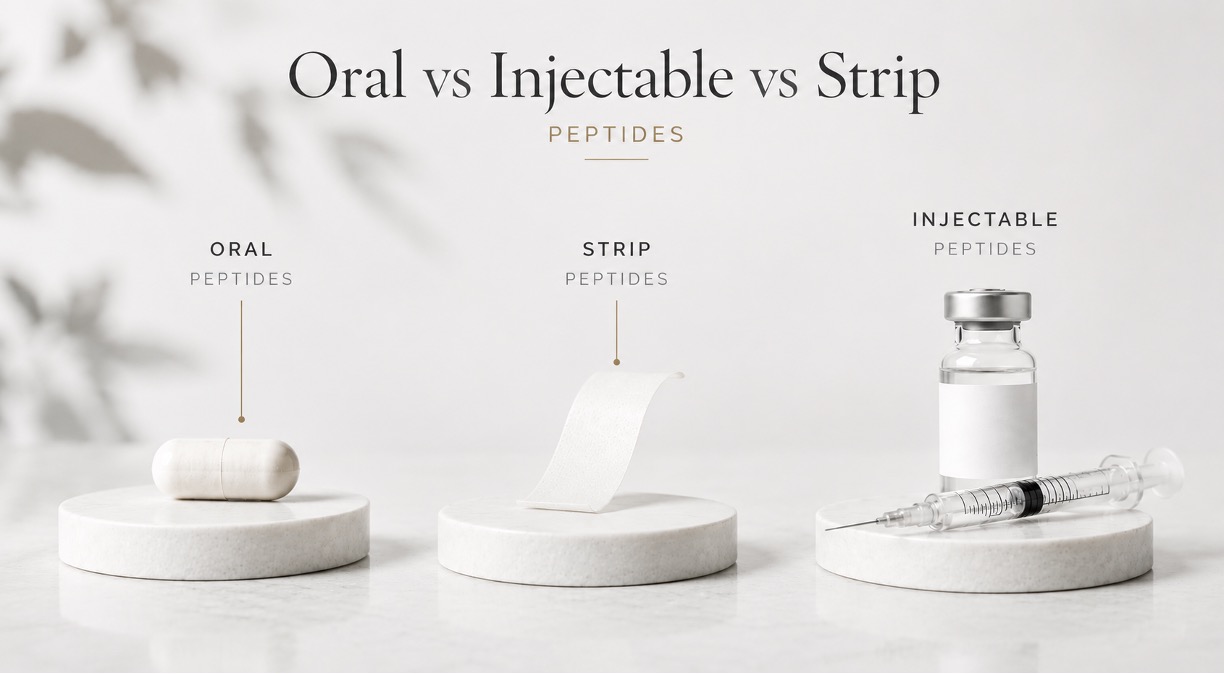
Oral vs Injectable vs Strip Peptides: Which is More Effective?
Compare oral, injectable, and strip peptides across absorption, onset, and convenience. See how Neuvera's oral strips deliver 92.5% absorption without needles.
Key Takeaways
Strip peptides are the newest format in the category and the strongest fit for daily routines. They dissolve on or under the tongue and are absorbed through the mucosa, achieving injectable-level absorption without needles, refrigeration, or mixing.
Injectable peptides reach 80% to 100% bioavailability and work within minutes, which is why they have been the default in clinical protocols. The trade-off is the needle, cold storage, site rotation, and prep, which cause many users to skip doses.
Traditional oral peptide pills are easy to take but absorb poorly. Stomach acid and digestive enzymes break down most of the peptide before it enters circulation, limiting how much active compound actually reaches the bloodstream.
Absorption numbers only matter if you stick to the routine. Strip peptides remove the friction that causes people to miss injections, which is why consistency tends to be higher with this format.
Neuvera's Daily Wellness Strips deliver study-backed 92.5% absorption with a 5 to 15 minute onset, giving you a needle-free daily format that does not ask you to trade convenience for results.
How Do Oral, Injectable, & Strip Peptides Compare?
Not all peptide formats are equal. Strip peptides sit at the top for daily use, combining injectable-level absorption with the kind of convenience that keeps routines consistent.
The two older formats each have a catch. With injectables, the absorption is strong but the routine is demanding. Refrigeration, needle prep, reconstitution, and rotating injection sites add enough friction that doses get missed. Oral pills remove all of that hassle, but the digestive system breaks down most of the peptide before it reaches the bloodstream, which limits results no matter how consistent you are.
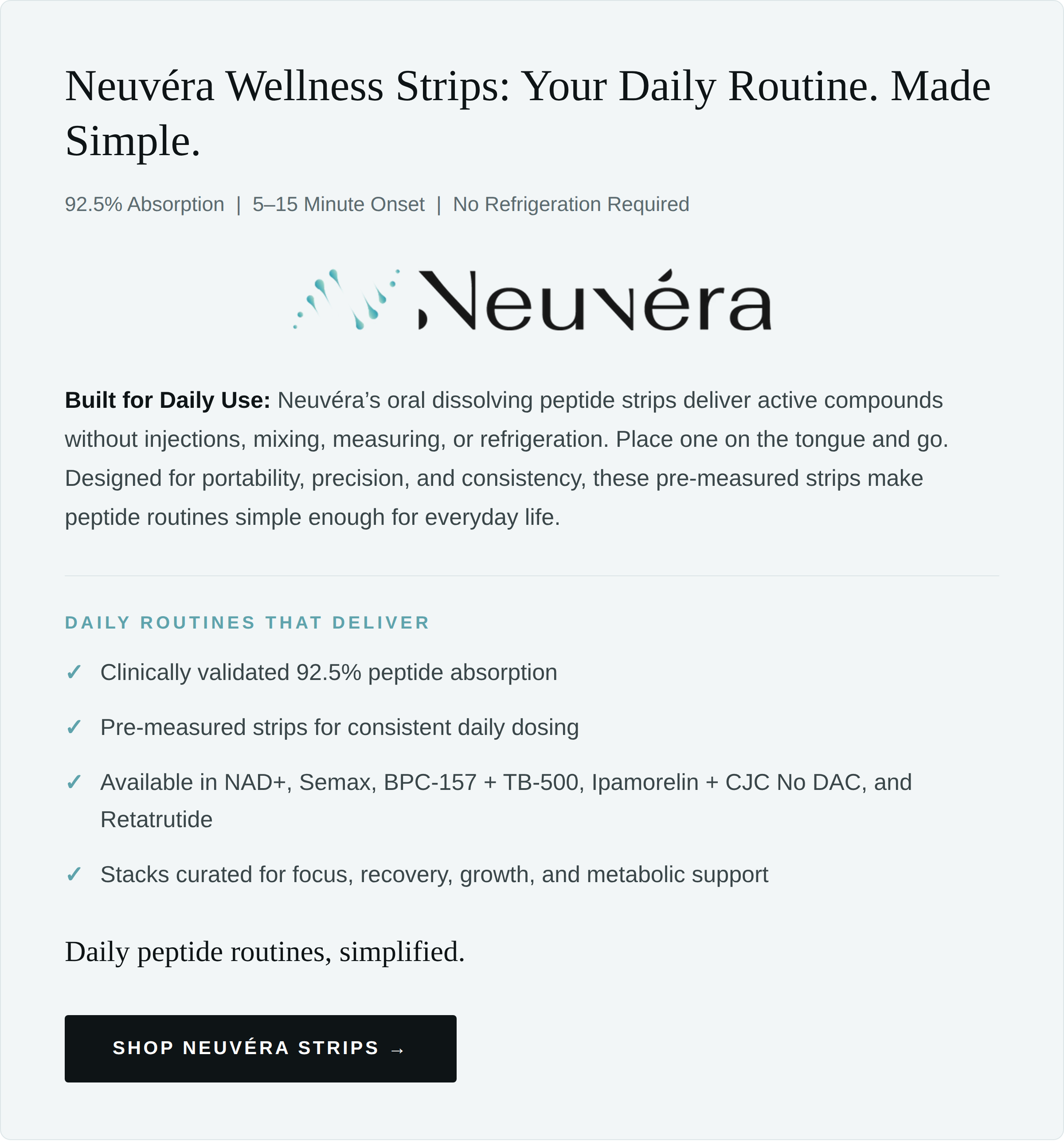
Neuvera’s Daily Wellness Strips were created to close that gap. Study-backed 92.5% absorption, a 5 to 15 minute onset, and zero prep make it a format designed around how people actually live. Here is how all three compare.
How Do Strip Peptides Work?
Strip peptides are the newest delivery format in the category. The peptide is loaded into a thin, dissolvable film that you place on or under the tongue. As the strip dissolves, the peptide passes through the highly vascularized tissue under the tongue and into systemic circulation.
This is called sublingual delivery, and the difference matters. Peptides are powerful but fragile. Stomach acid degrades them, and the liver metabolizes much of what survives before it reaches the bloodstream.
That two-step breakdown, called first-pass metabolism, is the main reason traditional oral peptides underperform. Strip peptides skip both stages entirely. The format also removes the parts of injectable use that tend to break consistency.
Bioavailability of Strip Peptides
Because strip peptides bypass digestion and first-pass metabolism, absorption is close to injectable levels. Neuvera's oral dissolving strips reach study-backed 92.5% absorption with a 5 to 15 minute onset, putting strip performance in the same range as subcutaneous delivery.
A buccal penetration review found the tissue under the tongue is 4 to 4,000 times more permeable than skin, which is why sublingual delivery can match injectable speed. The takeaway is consistent across the data. Sublingual delivery is faster and more efficient than swallowing, and far easier to maintain than injecting.
How Do Oral Peptides Work?
Oral peptides are taken by mouth, usually as capsules, tablets, or liquid. They travel through the entire digestive system before reaching the bloodstream.
The challenge is that stomach acid and the enzymes in the small intestine are built to break peptides down into their individual amino acids. The same process that keeps the body nourished is what limits how much of an oral peptide makes it through intact.
Bioavailability of Oral Peptides
For traditional oral peptides, the bioavailability has historically been low because of breakdown in the gut.
Modern formulation science is closing that gap with enteric coatings that protect peptides from stomach acid and smaller peptide chains, which absorb more readily than longer ones.
Even with these advances, most traditional oral peptide formats fall short of injection-level absorption.
How Do Injectable Peptides Work?
Injectable peptides are delivered directly into tissue, either just beneath the skin (subcutaneous) or into a muscle (intramuscular). This bypasses the digestive system, so the peptide reaches the bloodstream largely intact.
The result is faster onset and higher absorption than traditional oral formats. Most structured peptide protocols use subcutaneous injections delivered with a small insulin-style needle.
Bioavailability of Injectable Peptides
Injectable peptides typically achieve 80%–100% bioavailability, depending on the peptide and injection site. This high absorption is the main reason injections have been the default in clinical peptide protocols.
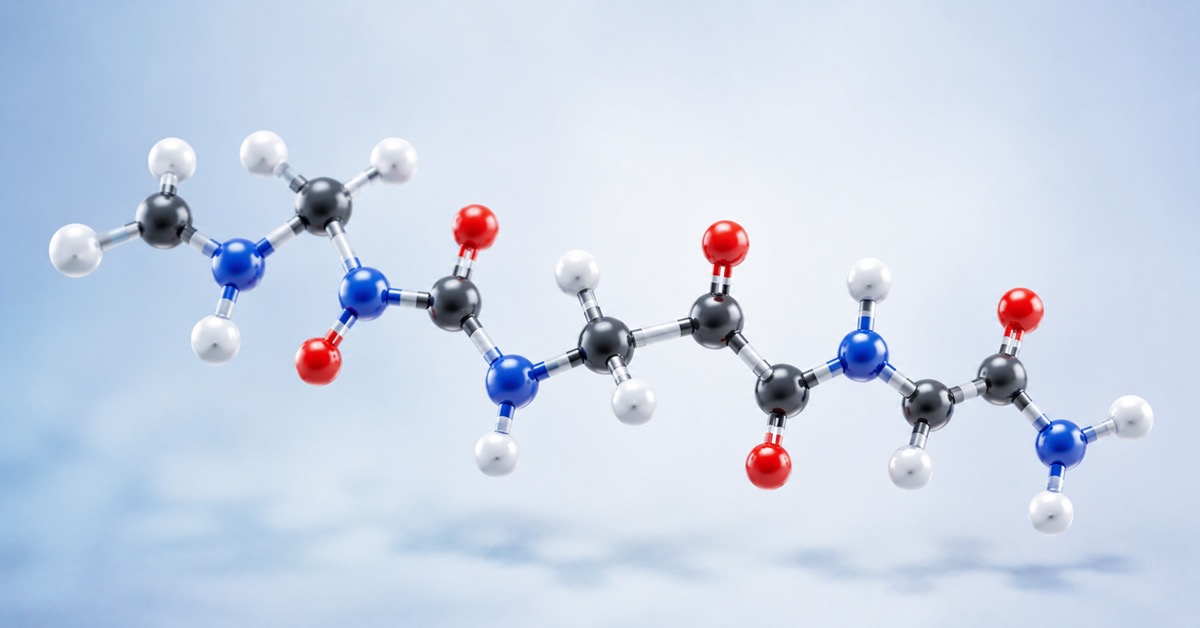
Peptides typically contain between 2 and 50 amino acids and help coordinate specific biological processes by acting as highly targeted cellular messengers.
Head-to-Head Comparison: Injectables vs Oral Pills vs Strips
Convenience & Ease of Use
Oral dissolving strips come out ahead in convenience. They skip the needles, injection technique, and refrigeration that most injectables require. That practical advantage directly shapes how consistently a person sticks to the routine.
Oral pills are also easy to take, but they trade off absorption for that simplicity. Injectables require more upfront effort. The technique has to be learned, refrigeration is often needed, and some users feel mild irritation during early use.
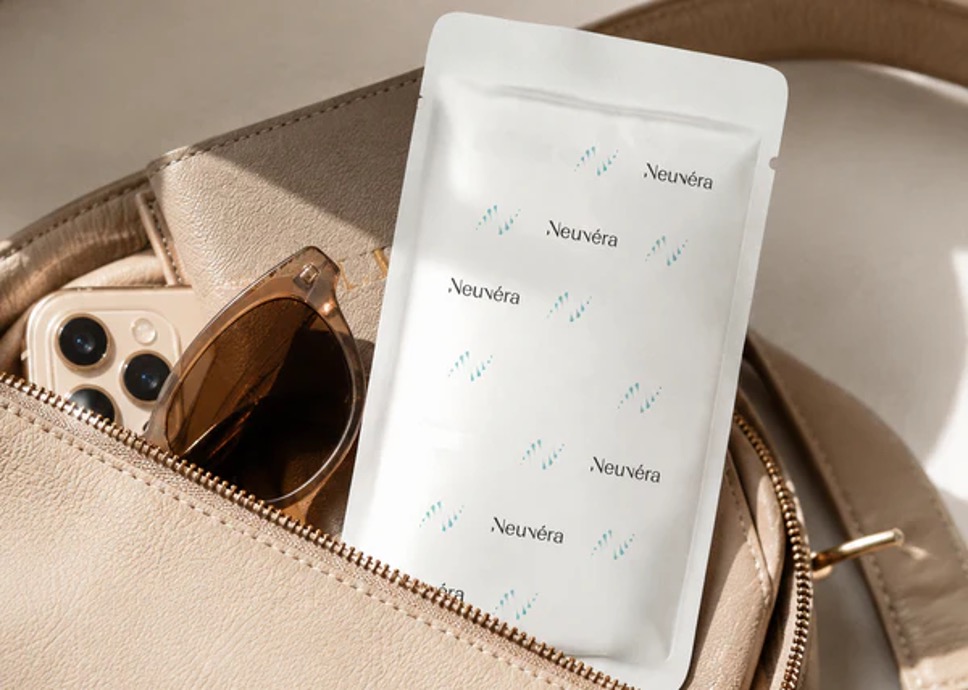
Subcutaneous peptide injections require rotating injection sites to avoid tissue irritation, which is a planning step that strips remove entirely.
Speed of Onset
Strips and injectables are close in terms of onset speed. For example, Neuvera's Daily Wellness Strips show a 5 to 15 minute onset because absorption happens through the mucosa rather than the gut. Injectables reach the bloodstream within minutes of the shot.
Oral pills work differently. They build up gradually as the digestive system processes them, which makes them better suited to slow, steady, long-term routines.
Cost Differences
Strip peptides offer strong value when you factor in what they replace. There are no syringes, no alcohol swabs, no cold storage, and no mixing supplies to buy separately. Each strip is one pre-measured dose, so there is no waste and no guesswork. For people who were spending on injectable supplies on top of the peptide itself, switching to a strip format typically reduces the total cost per routine.
Injectable peptides are generally more expensive once everything is factored in, including the peptide itself, syringes, alcohol swabs, and storage. Oral peptides usually have a lower per-dose cost and require fewer extras.
When absorption is brought into the math, the comparison gets more complicated. The cost per active dose absorbed depends on the specific peptide, the formulation used, and how effectively that formulation delivers the compound into circulation.
Oral vs Injectable vs Strip Peptides: Comparison Table
Factor | Strip Peptides (e.g., Neuvera’s Daily Wellness Strips) | Injectable Peptides | Oral Peptide Pills |
Delivery method | Dissolves on or under the tongue | Injected subcutaneously or intramuscularly | Swallowed as capsules, tablets, or liquids |
Absorption pathway | Bypasses digestion via the mucosa | Bypasses digestion via tissue | Passes through the digestive system |
Bioavailability | Study-backed 92.5% for Neuvera strips | 80 to 100%, depending on the peptide | Historically low |
Onset | 5 to 15 minutes | Within minutes of injection | Gradual buildup |
Dosing precision | Pre-measured, no guesswork | Requires measuring and mixing | Pre-measured |
Storage | Shelf-stable, portable | Often needs refrigeration | Shelf-stable in most cases |
Adherence | Easy to maintain | Drops when schedules slip | Easy to maintain |
Travel and portability | Shelf-stable, individually sealed, pocket-sized | Requires cold storage and supplies | Shelf-stable in most cases |
Best suited for | Needle-averse users, daily routines, format-switchers | Clinical protocols, fast onset | Gut-focused peptides, long-term routines |
How Neuvera Closes the Gap Between Oral & Injectable Peptides
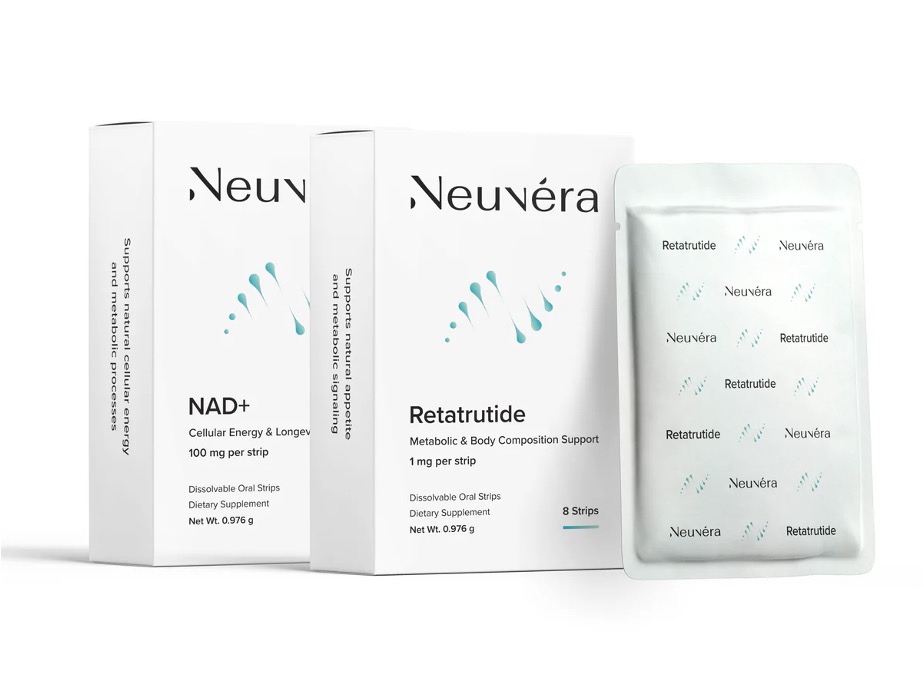
At Neuvera Life, our oral dissolving strips remove the needle while preserving the absorption that made injections the preferred format.
Oral and injectable peptides each have a place in a peptide routine. Injectables win on raw absorption and speed. Traditional oral formats win on convenience. The format that produces the best real-world results is the one a person can follow consistently, day after day, without friction getting in the way.
At Neuvera Life, our oral dissolving strips deliver peptides directly into the bloodstream via the mucosa, bypassing the digestive breakdown that limits capsules and tablets. If you want to add a study-backed, needle-free format with 92.5% absorption to your daily routine, our daily wellness strips are pre-measured, shelf-stable, and ready to go wherever you do.
Try Neuvera Daily Wellness Strips Today.
Frequently Asked Questions (FAQs)
Are oral peptides ineffective compared to injections?
Not at all. Traditional oral peptides absorb less efficiently because the digestive system breaks down much of the peptide before it reaches circulation. Strip peptides, like Neuvera's oral dissolving strips, raise the bar by absorbing through the mucosa under the tongue, skipping the digestive breakdown entirely.
How are strip peptides different from regular oral peptides?
Regular oral peptides are swallowed and travel through the stomach and intestines, where much of the peptide is broken down. Strip peptides dissolve in the mouth and absorb through the mucosa, so the peptide enters the bloodstream directly. That single change in the pathway is why strips reach absorption levels closer to injections.
Can you switch between oral and injectable peptides?
Yes, and many people use both formats strategically depending on the season of their routine. Dosing may need adjustment between formats because absorption rates differ, so a milligram-for-milligram swap is rarely a clean equivalence. The most important thing is to plan the transition rather than treat the two formats as interchangeable on the same day.
Do injectable peptides require a prescription?
In the United States, many therapeutic peptides used for injection are classified as prescription compounds and must be obtained through a licensed healthcare provider. Oral peptide products sit in a different regulatory category, with some sold without a prescription. The absence of a prescription requirement reflects regulatory classification rather than a verdict on safety or quality.
How fast do oral dissolving peptide strips work?
Oral dissolving peptide strips work within minutes because they bypass the digestive system and are absorbed through the mucosa under the tongue. Neuvera’s Daily Wellness Strips reach study-backed 92.5% absorption with a 5 to 15 minute onset, comparable to what active injectable users typically expect.
*Disclaimer: The information in this article is for general informational purposes only and is not intended as medical advice, diagnosis, or treatment. Neuvera's products are not pharmaceutical products. Individual results may vary. Always consult a qualified healthcare professional before starting any new wellness routine.
Written by Cody Nickson
READY TO CHOOSE?
Find your daily strip routine.
Answer one simple question: what are you building around? Then compare Neuvéra routines by goal.